
Festivals are great opportunities to see films that may never circulate and that most of the time reserve great surprises, remaining impressed in our memory by way of emotion, or for a scene, a story, an icastic element. Among the films that I think deserve to be talked about in the context of the Rome Film Festival and that I hope will soon find a distribution, I chose the Norwegian film Skyggenes Dal (Valley of Shadows, also present on Imbd here) by Jonas Matzow Gulbrandsen, who wrote it together with Clement Truffeau, with music by Zbigniew Preisner. This is a film of great dramatic beauty that conveys, with a strongly visual impact, the emotions of an estranged fairy tale in the form of a coming of age story.
Little Aslak (Adam Ekeli) is six years old, he lives with his mother and the dog Rapp in a large empty house where memories and remnants of an older brother are closed behind the door of a room – objects he has left and that Aslak finds as little treasures. One day, Aslak is called by a friend and is shown three sheep from the flock of his friend’s father, torn apart during a full moon night by what Aslak’s friend believes to be a werewolf. The boy thinks that the “monster” could live in the great forest on top of the hill, an impression confirmed also by the fact that the shepherds are preparing poisoned baits to be distributed in the forest to capture it.
Shortly afterwards, Aslak’s mother receives a visit from the police who tell her about some dramatic news. Aslak looks at the scene from the window without understanding what is going on; he only sees her mother crumbling desperately. Has anyone fled? Is anyone, who his mother knows, responsible for the slaughter of sheep? Could there really be a werewolf? One day, while the child is walking with the dog on the windy slope, the animal moves away and Aslak goes looking for him, reaching the fenced entrance to the forest; he is attracted by the mysterious atmosphere but also frightened. Returning home, he decides the day after to go alone to look for the dog that has not yet returned; he enters the forest and begins to explore the disturbing and mysterious place until he finds himself lone and lost; he wanders among the trees and loses the sense of time, while the camera follows the child with a diluted narrative point of view that extends the awesome experience. The story becomes more and more dreamlike as Aslak continues his search and finds himself amidst a “temple” of signs, noises, mysterious movements – a secret language of beauty and fear.
In the directing notes, the director said he wanted to make a film that “reflected a child’s mind and point of view”. Filtering everything with the eyes of little Aslak, who finds himself crossing a threshold that is both real and symbolic, the real world is tinged with gothic and marvellous nuances (very beautiful is the scene of the forest at night or the crossing of the stream amidst the fog), in which the amazing nature and the dangerous journey of the kid convey emotions just as a fairy tale would do, without however, letting the story merge completely with it. The fairy tale always remains on the background of the narrative, and in doing so, the films creates an ambiguity that perfectly merges with the stage narration.
The director, in fact, wanted to avoid the magical realism that such a story could have entailed, entrusting to the viewpoint of the child observer a series of dramatic possibilities and nuances that bring the story back to a coming of age tale, narrated with simplicity and powerful imagery – the appearance of an animal, the sounds of the forest and the movement of water while Aslak is carried away on the boat are simple yet magical moments of knowledge and experience that add a poetic nuance to the sense of existential solitude. Choosing to concentrate the dialogues, making them simple and essential, and entrusting the images with the function of carrying out the story, the strange and astonished Aslak’s point of view, arouses in the viewer all those ambiguities and emotions that only a childish gaze in fairy tales or legends may do so effectively.
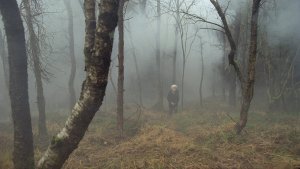
The sound and the music are beautiful and evoke the awe and pain of a nature that is both lonely and self-sufficient. The emotion of a sublime and powerful nature still subjugates our human condition because it is seen with the eyes of a human presence that is also “uncontaminated” by adult views of the world; after all, Aslak is endowed with a peculiar innocence that is touching but also capable of a peculiar resilience. Because if nature is a strange, mysterious, and unfathomable place of its own, it is also full of presences, shadows, noises and movements that make it up a universe of life (which really is, as those who love wild places well know) completely independent from the human world and deeply alive. A place that should be comprehended, feared and after all tamed but that Aslak reveals as a magical place of its own. When Aslak begins to walk, finding himself in a wide clearing scattered with dark pools of water, there is nothing unreal or terrible except the perception of the immense loneliness in which he is going astray, losing the sense of time (we see him taken up again in the long field, standing out against the immensity of natural space). We don’t know how big and dismal the forest actually is, but in Aslak’s eyes it appears extended and grandiose, as well as the sounds it produces that are evocative, disturbing, mysterious. The appearance of a huge, marvellous animal makes him escape and stumble through the trees; exhausted and forlorn he falls asleep, then awakens and discovers that the forest is inhabited by someone who may perhaps help him.
Valley of Shadows is a coming of age story, if you like, about the discovery of self but also, for the viewer, a beautiful tale apparently simple, in that it is divided into precise stages: the doubt, the crossing of the threshold, the magic companion, the dream, the relationship with death, the return, the final reward. Aslak’s pilgrimage to the forest is in fact a symbolic path towards himself and an attempt to pass through an experience that is liminal to the perception of death but it is actually surrounded by curiosity and wonderment. All of this would perhaps have appeared obvious with an adult character; it is instead very moving with a child because it acquires an unexpected force, as unexpectedly beautiful is the whole film, with its elliptical dialogues, its simple situations and its profoundly poetic dimension.
A few years ago, when I was studying Nordic mythology and literature, I had come across the livid tones and the essentially elliptical substance of Scandinavian dialogues. I have always thought that each culture has its own specific representation of two distinctive elements: Nature and loneliness. Unlike the Mediterranean culture, to which I obviously feel to belong, Scandinavian culture has a very different relationship with Nature, at least on the symbolic level for which the tones and nuances of Gothic become congenial (it’s not by chance that the film is defined as a Scandinavian Gothic on Imdb, a definition that is somewhat reductive but not incorrect), but Scandinavians also seem to have a certain resistance to show emotions through dialogue and speech contrarily to what happens more frequently in other cultural traditions (not to mention the expressiveness we show in Mediterranean cultures compared to the sober economy in which expressions seem to convey emotions in Nordic cultures).
I have always believed that the sense of the sublime, as the Romanticism understood it, is essentially an invention of northern Europe, whose representation strikes a chord when loneliness of the individual in nature is concerned and when this encounter symbolises the search for the inner self. The German word waldeinsamkeit (translatable somehow with the expression “the sense of solitude in the forest”; here there is an article about the term) indicates precisely the sublime, terrifying and magical condition of the individual feeling alone in the forest, surmounted and surrounded by a nature that can be terrible or benign but always sublime. Beyond these elements, I believe that Valley of Shadows is a very beautiful film with great emotional impact that never linger on pathetic elements (the sorrow of Aslak’s mother’s (Kathrine Fagerland) is depicted with an admirable sobriety), but rather maintains a great symbolic consistency even when it is rather “literal”, succeeding in arousing powerful emotions and great empathy in the viewer.
 La lettrice immaginaria